
As the rupee remains under pressure due to several headwinds and the uncertainty around the India-US trade deal, the Reserve Bank of India (RBI) has been stepping in only to calm volatility, not to stop the fall.

The Reserve Bank of India's rate-setting panel on Wednesday started discussions to firm up the next bi-monthly monetary policy amid expectations that it might retain status quo on interest rate but change its monetary policy stance amid rising inflation on account of geopolitical developments.

'The government's decision to keep interest rates unchanged on small savings schemes will certainly constrain banks' ability to cut deposit rates further.'

Uncertainties over the impact of the United States' (US') tariffs on India, along with the ongoing transmission of past rate cuts, prompted the members of the Reserve Bank of India's Monetary Policy Committee (MPC) to maintain the status quo during the August meeting, the minutes showed. While some of the external members highlighted their concern over growth, the internal members cited the one-year headline inflation rate overshooting the 4 per cent target.

An end to easy money policy could lead to higher cost of funds, which could hurt investments and stunt growth.

Reserve Bank Governor Sanjay Malhotra on Wednesday said there is no proposal to levy any charge on UPI transactions.

Analysts at Morgan Stanley have updated their outlook for the Indian markets, and they now expect the Sensex to hit the 107,000 mark by December 2026 in a bull-case scenario, translating into an upside of 26 per cent from current levels.
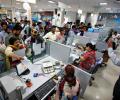
The Indian banking sector could be due for a rise in profitability after several quarters of net interest margin (NIM) compression. The Q2FY26 results suggest NIMs have bottomed out.

'We have seen that stablecoins lack the basic attributes of money, their advantages are neither unique nor unambiguous and their risks are all too real.'

Private sector banks slipped in market capitalisation (mcap) during the July-September quarter, underperforming their government-owned peers as trade uncertainties dragged market sentiment, said S&P Global Market Intelligence. According to its analysis, HDFC Bank shed 4.8 per cent in mcap during the third quarter, while ICICI Bank's dropped 6.7 per cent.

Monetary policies worldwide has to deal with issues like controlling inflation, promoting growth and financial stability.

Foreign portfolio investors (FPIs) remained net sellers of Indian equities in September, withdrawing Rs 23,885 crore (around $2.7 billion) and taking year-to-date outflow to Rs 1.58 lakh crore ($17.6 billion).

'If there is an RBI majority in the committee, there is no question of a veto.'

Among Sensex firms, ITC, Bharti Airtel, Trent, Bajaj Finserv, Titan and Reliance Industries were the major laggards. However, UltraTech Cement, Adani Ports, Tata Motors, Bharat Electronics, Bajaj Finance and Hindustan Unilever were among the major gainers.
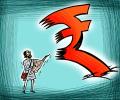
The rupee plunged 26 paise to an all-time low of 90.75 against the US dollar in intra-day trade on Monday, weighed down by uncertainty over an India-US trade deal and persistent foreign fund outflows.

Takao replaced Haruhiko Kuroda, who had, in March, quit ADB to take charge as Japan's central bank governor.
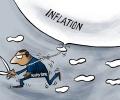
'Deposit and lending rates have started to fall considerably. It is likely to spur investment and consumption of durables.'

India has managed high government debt-to-GDP, a slowing domestic revenue engine, lower household savings and a more hostile geopolitical environment separately in the past. But together, they threaten to undo the growth narrative on which today's optimism rests, warns Debashis Basu.

For commercial banks to float subsidiaries, approval from the Reserve Bank of India (RBI) may not remain mandatory, according to highly placed sources.

Eternal was the biggest gainer in the Sensex pack, jumping 4.50 per cent, followed by Power Grid, ICICI Bank, Reliance Industries, UltraTech Cement, Adani Ports, Sun Pharma, ITC and Hindustan Unilever were also among the winners. In contrast, IndusInd Bank, Axis Bank, Bajaj Finserv and Bajaj Finance were among the laggards.

Despite a strong 7.8 per cent growth in the first quarter, the Indian economy is expected to grow at 6.5 per cent in the current financial year as the impact of US tariffs on Indian exports will reduce prospects, particularly in the second half, ADB said on Tuesday.

The change in stance to neutral from accommodative in the June monetary policy meeting does not necessarily signal that the Reserve Bank of India's (RBI's) rate setting body - monetary policy committee (MPC) - will go on a prolonged pause on rate cuts going forward, believe experts.

Stock market investors this week would track the renewed tariff tensions between the US and China, domestic inflation data, besides, quarterly earnings from blue-chips HCL Tech, Infosys and Reliance Industries would also drive the momentum in equities, analysts said.

The Reserve Bank of India (RBI) on Tuesday announced a fresh round of liquidity measures through open-market operations (OMOs) and a foreign exchange buy-sell swap, under which it will inject close to Rs 3 trillion into the banking system. The central bank said it would purchase Government of India securities worth Rs 2 trillion through OMOs, spread across four tranches of Rs 50,000 crore each to be conducted on December 29, January 5, January 12 and January 22.

The rupee continued to face pressure in the first half of the current financial year (FY26), hitting fresh lows against the dollar, due to strengthening of the greenback, rising crude oil prices, and foreign outflows. Rupee has depreciated by 3.7 per cent so far in the current financial year after starting at a good note in April.

The Indian economy is likely to grow at 7.4 per cent in 2025-26, up from 6.5 per cent in the previous fiscal, mainly on account of better performance of manufacturing and services sectors, as per the government data released on Wednesday.

The Indian government has expressed its disagreement with the IMF staff's 'baseline' assumption that the 50 per cent US tariffs on its goods exports 'would remain in place indefinitely', based on which the staff pegged the country's GDP growth at 6.6 per cent this year, and pared its 2026-27 projection by 20 basis points to 6.2 per cent.
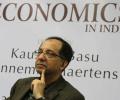
Former World Bank Chief Economist Kaushik Basu on Thursday said the US economic policy towards India has taken an unfortunate turn, noting that President Donald Trump's harsh stance against New Delhi appears baffling. US President Donald Trump on Wednesday announced a 25 per cent tariff on Indian goods from August 1, amid signs of a stalemate in the ongoing bilateral trade negotiations between the two countries.

If Chinese growth starts falling, sharply or otherwise, the risk on trade might reverse.
While participants in the domestic financial market are expecting a 25 basis-point policy repo rate cut in the December meeting of the Monetary Policy Committee (MPC) of the Reserve Bank of India (RBI), economists remain torn between a reduction in rate cut and a pause.
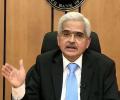
Reserve Bank Governor Shaktikanta Das on Tuesday said the fiscal-monetary coordination was at its best during the last six years even as he thanked Prime Minister Narendra Modi for giving the opportunity to head the monetary authority of the country. Das, in a series of posts on X, on his last day of his six-year term as RBI Governor, also thanked the Finance Minister, various stakeholders and his colleagues at the central bank.

'The US reciprocal tariff has added another element of uncertainty and the central bank may prefer to wait and get further clarity.'

The Reserve Bank on Wednesday revised upward its growth estimates for the current fiscal year to 6.8 per cent and lowered its inflation projection to 2.6 per cent based on an above-normal monsoon and the rationalisation of GST rates.

In a bid to promote the use of domestic currency for cross-border settlements, the Reserve Bank on Wednesday announced a slew of measures, including allowing banks to lend in Indian Rupees to non-residents from Bhutan, Nepal and Sri Lanka for bilateral trade.

India is growing fast, but to keep growing strong, the government must make more things at home, create jobs, and spend money wisely, suggests Rajiv Memani, regional managing partner, Africa-India Region, EY.
Reserve Bank on Friday decided to cut Cash Reserve Ratio (CRR) by a huge 1 per cent, which will unlock Rs 2.5 lakh crore liquidity to the banking system for lending to productive sectors of the economy. With the reduction in four equal tranches ending November 29, 2025, the CRR would come down to 3 per cent.

Indian corporates collectively raised over Rs 17,500 crore from the domestic debt capital market through bond issuances on Tuesday. The issuances were led by Bharti Telecom's Rs 10,500 crore fundraise in two tranches, the largest by an Indian company in the domestic market so far in FY26.

Indian economy remains a key driver of global growth on the back of sound macroeconomic fundamentals and prudent policies, the Reserve Bank said on Monday. In its bi-annual Financial Stability Report (FSR), the central bank also said elevated economic and trade policy uncertainties are testing the resilience of the global economy and the financial system.
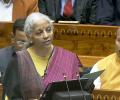
Budget 2026 sticks to fiscal discipline, shuns populist measures despite five key state elections coming up, but ends up rattling stock markets with a higher transaction tax on derivatives trading.

The Indian services sector growth touched an 11 month high in July, supported by a pickup in new exports orders and sharp rise in overall sales, a monthly survey said on Tuesday. The seasonally adjusted HSBC India Services PMI Business Activity Index was at 60.5 in July, little-changed from 60.4 in June, and the rate of expansion was the best seen since August 2024.
 © 2026 Rediff.com - Advertise with us - Disclaimer - Privacy Policy - Sitemap - Feedback - About us - Terms of use - Grievances